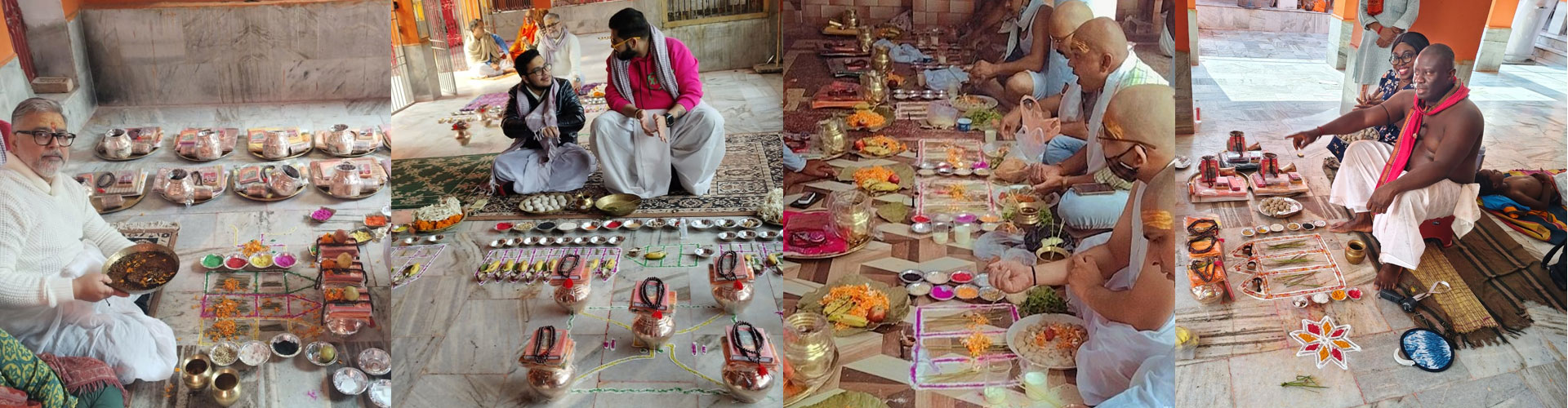

How To Do Pind Daan In Gaya: Step By Step Guide
Pind Daan in Gaya is sought after by thousands of pilgrims from across the globe to seek final liberation for their ancestors. It is a Hindu belief that every family must visit Gaya at least once in their lifetime to perform Pind Daan and associated rituals for their ancestors, for a final release and peace in the afterlife. In this blog, we will provide a comprehensive guide for Pind Daan in Gaya.
1. What is Pind Daan?
Pind is the circular balls made up of rice or wheat flour, which represent the body of the ancestors, and Daan is the offering of these rice or wheat balls to the ancestors with the proper Vedic chanting. A mixture of water, milk, sesame seeds, barley, etc., is poured on the Pind with Vedic chanting.
2. Types of Pind Daan in Gaya:
One Day: Pind Daan is offered at all three main places in Gaya, namely the Vishnupad Temple, Akshay Vat, and the Phalgu River. Most families visiting Gaya perform Pind Daan on the same day. They also perform TriPindi Shradh and Narayan Bali Shradh, along with Pind Daan, to remove Pitru Dosha.
Three Days: Pind is offered at forty-five places in Gayaji. Families perform it with no time constraints and can stay in Gaya for a minimum of 3 days.
Apart from the above two, which are performed, families also perform five-, seven-, fifteen-, and seventeen-day rituals, based on their customs and beliefs.
3. Benefits of Pind Daan in Gaya:
There are numerous benefits to performing Pind Daan in Gaya, and they can vary from person to person. Given below are some common benefits of Pind Daan in Gaya:
1. Free From Ancestral Liability (Pitru Rin): Pitru Rin, or ancestral liability, needs to be cleared as it is considered inauspicious in Hindu belief for the growth of the family. Therefore, performing Pind Daan in Gaya frees one from all the ancestral liability as the souls of the ancestors find final peace and liberation.
2. Removal of Pitru Dosha: When, for some reason or another, the last rites of the deceased are not performed properly, or in cases of unnatural deaths due to disease, accidents, etc., it is believed that such families face Pitru Dosha and that the souls of the ancestors are not satisfied. Therefore, performing Pind Daan in Gaya provides them with final peace and liberation.
3. Physical Well-being: Physical well-being is also directly related to performing Pind Daan in Gaya. It is believed that if the souls of any ancestors are unhappy, it can also cause physical ailments in the family. Performing Pind Daan in Gaya provides the ancestors with final peace and liberation, thus bringing physical well-being to the family.
4. Blessings From Ancestors: Performing Pind Daan in Gaya clears all blockages in the afterlife, which makes ancestors happy, and in return, they provide blessings to the family members.
Where to Perform Pind Daan in Gaya:
Pind Daan in Gaya is mainly performed at three central locations: Akshay Vat, Vishnupad Temple, and the Phalgu River. Pind Daan at these three locations is performed as part of the one-day Pind Daan protocol in Gaya. Apart from these, other places in Gaya fall under the Pind Daan protocols of three, five, seven, fifteen, and seventeen days. These locations are Punpun, Godavari, Falgu River, Pretshila, Brahmakund, Ramkund, Ramshila, Kakbali, Uttarmanas, Dakshinmanas, Udichi, Kankhal, Jihwal, Gadhadhar Vedi, Sharswati Vedi, Matangwapi, Dharmaranya, Bodhitaru, Brahma Sarovar, Kaakbali (Maranpur), Aamrasechan, Tarak Brahma, Rudra Pad, Brahma Pad, Dakshinagni Pad, Garhapatya Agni Pad, Aahwaniya Agni Pad, Avasthya Agni Pad, Sandhyagni Pad, Surya Pad, Chandra Pad, Ganesh Pad, Kartikeya Pad, Indra Pad, Agastya Pad, Kashyap Pad, Kanva Pad, Matang Pad, Dadhichi Pad, Gajakarna Pad, Sitakund, Ram Gaya, Gaya Seer, Gaya Kup, Mund Pristha, Aadi Gaya, Dhaut Pad, Waitrani (Vaitarani), Bheem Gaya, Goprachar, Akshay Vat, Gadalol, Gayatri Ghat.
It depends entirely on family customs and traditions to choose the number of days for Pind Daan in Gaya. Given below are the brief details of all three central locations of Gaya:
Akshay Vat: It is one of the most sacred locations in Gaya for Pind Daan, as it is believed that Vishnu Ji himself resides in this tree and grants liberation to the souls of the deceased who offer Pind Daan here.
Vishnupad Temple: It is the leading site in Gaya, where Pind is offered to the ancestors, and the temple is believed to mark Vishnu's footprints, where it is thought that Vishnu liberated Gayasur.
Phalgu River: It is another important site in Gaya where Pind is offered to the ancestors as a final offering and release.
Procedure of Pind Daan in Gaya:
Pind Daan in Gaya goes through the following procedures:
1. Pind Daan starts with Sankalpam, which can include the name of the doer, the Gotra of the family, the names of the ancestors and the purpose of performing Pind Daan, which is then followed by holy bathing at the Phalgu river.
2. Tarpan and Pind Daan: Tarpan is offered to the ancestors by providing a mixture of water, milk, sesame seeds, barley, etc. Pind, round balls are prepared with rice or wheat flour and Daan (offered) to the ancestors. Three to five rice balls are prepared, each representing one generation.
3. Pind is offered at various Vedis in Gaya, namely Akshay Vat, Vishnupad Temple, Phalgu River, Pret Shila, Ram Shila, Brahma Sadan, Sita Kund, etc. There is a total of 54 Vedis in Gaya.
4. Feeding the Brahmins and Donations: After the successful completion of the Shradh, Brahmins are fed, and donations are given to the family of the Brahmins as a token of gratitude for their valuable service.
Who can perform Pind Daan in Gaya, and when:
The eldest male member of the family is eligible to perform Pind Daan. If he is not present, younger ones, including females, can also perform Pind Daan in Gaya.
Pind Daan in Gaya can be offered at any time of the year. It can also be performed during Pitru Paksha, Amavasya, Panchami and Astami Tithis.
List of Pooja Materials(samagri) for Pind Daan in Gaya:
Given below are the general list of items required for Pind Daan in Gaya. The items of the list can change depending on the type of Pind Daan. Please confirm it with an expert Pandit in Gaya before purchasing it:
|
Rice (Bhaat) |
Flowers |
|
Black Til (Black Sesame Seeds) |
Garlands |
|
Barley (Jau) |
Betel Leaves (Paan Patra) |
|
Ghee |
Betel Nuts (Supari) |
|
Cow Milk |
Havan Samagri |
|
Honey |
Dry Wood (Samidha) |
|
Kusha Grass (Darbha) |
Camphor (Kapoor) |
|
Gangajal / Sacred Water |
Oil Lamp (Diya) |
|
Kumkum (Roli) |
Cotton Wicks (Batti) |
|
Haldi (Turmeric) |
Mustard Oil / Ghee (for Diya) |
|
Chandan (Sandalwood Paste) |
Incense Sticks (Agarbatti) |
|
Akshat (Unbroken Rice) |
Dhoop |
|
Coconut |
Fruits |
|
Sugar / Mishri |
Sweets (Naivedya) |
|
Water Pot (Lota / Kalash) |
Pooja Plate (Thali) |
|
Small Bowls (Katori) |
Leaf Plates (Dona / Pattal) |
|
Matchbox / Lighter |
Sacred Thread (Kalava / Moli) |
|
White Dhoti / Kurta |
Angavastram / Towel |
|
Dakshina |
— |
Pind Daan Cost and packages in Gaya:
|
Pooja Type |
Description |
Approximate Cost (INR) |
|
Pind Daan (One Day) |
Ritual offering of rice balls and water to ancestors at three locations |
₹4,500 - ₹7000 |
|
Pind Dan (Three Days) |
Ritual offering of rice balls and water to ancestors at 35-45 locations. |
₹15,000 – ₹21,000 |
SEND ENQUIRY
Conclusion:
Pind Daan in Gaya is a very potent ritual to provide final peace and liberation to the souls of our ancestors. Gaya is considered the place of liberation, therefore, every Hindu living anywhere in the world seeks to perform Pind Daan in Gaya for their loved ones. Performing Pind Daan in Gaya gives final resting peace to the ancestors in the afterlife.