FAQ'S
1. How to Book Mahamrityunjaya Jaap in Varanasi?
The booking process for Mahamrityunjaya Jaap in Varanasi is quick and straightforward. It is recommended to always opt for advance booking rather than relying on the physical journey to Varanasi and then spend the whole day searching for a good and qualified pandit. If you use a referral from a family member or friend who has already used the service, it's worth booking. But if you are completely new to Kashi and want the best possible experience with Mahamrityunjaya Pooja, online booking through various pooja and pandit service providers is always recommended.
These online pandit booking platforms take care of all of the needs of the Pooja. They will arrange expert pandits, select an appropriate venue for the Pooja, and procure all Pooja materials, including Havan materials, flowers, and fruits. It is recommended to personally review the reviews and feedback of these service providers and make a direct phone call to better understand and ensure clear communication.
These service providers also guide you with accommodation and a local itinerary upon enquiry during your stay in Varanasi.
2. How Many Pandits Are Required for Mahamrityunjaya Jaap?
The total number of pandits required for a 1.25 lakh Jaap count is around 35-40 brahmins for a one-day Pooja. If it lasts for three, five, or seven days, the number of brahmins will be distributed accordingly. However, the total number of brahmins will always fall within the same range as the given number of days above. Given below is a chart for all the types of Jaap counts which people generally follow for Mahamrityunjaya Pooja:
| Total Jaap Sankhya |
Number of Pandits |
| 11,000 Jaap |
3 Pandits |
| 21,000 Jaap |
5 Pandits |
| 31,000 Jaap |
7 Pandits |
| 51,000 Jaap |
9 Pandits |
| 1,25,000 Jaap |
35-40 Pandits |
| 5,00,000 Jaap |
150-160 Pandits |
3. How Long Does Mahamrityunjaya Jaap Take?
The duration of the Mahamrityunjaya Jaap depends entirely on how many times it is chanted. If the Jaap count is the standard 1.25 lakhs, the duration depends on the intention taken before the start of the Pooja. The number of days is usually decided in advance, and then the number of brahmins is decided accordingly.
If the Pooja protocol is decided on a given day, then 35-40 brahmins will be required.
If the three-day Pooja protocol is decided, then 11-13 brahmins are required each day.
If the five-day Pooja protocol is decided, then 7-9 brahmins are required each day.
4. What is the best day and Muhurat for Mahamrityunjaya Jaap?
The best day and muhurat for Mahamrityunjaya Jaap can be decided by an expert pandit ji or astrologer based on the astrological charts or the family's needs.
However, some suitable dates for this Pooja are given below:
1. It can be started on any Monday of Krishna Paksha or Shukla Paksha. Mondays are considered the day of Shiva himself.
2. It can be started on any Pradosh of the month, as it is also considered to be a conducive date for the Pooja.
3. It can also be started on any special days such as Shivratri, Shravan month, etc.
5. What is the best place for Mahamrityunjaya Jaap in Varanasi?
Mrityunjaya Mahadev Temple in Varanasi is the most sought-after place for the Mahamrityunjaya Jaap. It is the abode of Shiva as Mrityunjaya, meaning one who has conquered death. This temple is dedicated solely to devotees seeking freedom from untimely death, health, healing, well-being, and protection. It is also the best place for devotees suffering from chronic ailments. It is believed that the Mahamrityunjaya Jaap, when chanted here, frees the individual from chronic ailments.
6. Why is the Mahamrityunjaya Jaap performed in Varanasi?
Varanasi is the abode of Shiva, and he is the conqueror of death and bestower of life to devotees. The whole of Varanasi is charged with Shiva energy and is described as situated on the trident of Shiva. Shiva himself protects all living and nonliving beings in Kashi. Therefore, when the Mahamrityunjaya Jaap is chanted in any sacred place in Varanasi, it is believed to protect devotees from untimely death and to free them from chronic ailments.
7. What is 1.25 lakh Mahamrityunjaya Jaap?
The 1.25 lakh Mahamrityunjaya Jaap is considered a highly potent Pooja for those suffering from any chronic disease. The literal meaning of the mantra is ‘victory of death’. It is also performed during the pre- and post-operative periods to ensure a smooth operation and a faster post-operative recovery. The mantra goes like Om Tryambakam Yajamahe Sugandhim Pushtivardhanam Urvarukamiva Bandhanan Mrityor Mukshiya Maamritat. It is performed as a one-day, three-day, five-day or seven-day Pooja protocol. The total number of brahmins is between 35 and 40. It is suggested that it be performed in sacred spaces charged with Shiva energy.
It starts with the Gauri-Ganesh Pooja, followed by the Kalash-Navgrah Pooja. Rudrabhishek is performed after taking the Sankapalm (Intention) for the Pooja. 1.25 lakhs mantra is chanted over a period of one, three, five or seven days in the guidance of an expert pandit ji. The Pooja is completed with Dasams Havan (one-tenth of the Jaap is offered as a fire oblation), followed by aarti and the distribution of prasad.
Donations and feeding of the brahmins mark the final completion of the Pooja.
8. Can Mahamrityunjaya Jaap be performed for someone else?
Yes, Mahamrityunjaya Jaap can be performed for anyone. The main part of any pooja process is the intention (Sankalpam), which is taken at the start of the Pooja. The name, gotra, nakshatra and the intention of the Pooja are taken at the start of the Pooja. It can even be taken online these days, as digital media use grows. There is no difference between online and offline Pooja as long as the intention behind the Pooja is properly observed. The results are equally beneficial.
Anyone can take the intention for anyone and start chanting, following the standard Pooja protocol. The help of Brahmins can also be taken for Dasams Havan, which is the one-tenth offering of the mantra chanted as fire oblations.
9. Can Mahamrityunjaya Jaap be performed online?
Yes, Mahamrityunjaya Jaap can be performed online. There is no difference between online and offline pooja. The main part of any pooja is the intention (Sankalpam) part of the Pooja, which is taken at the start of the Pooja with the name, gotra and nakshatra of the person in whose name the Pooja will be performed. It can also be taken online these days with the growing digital penetration.
Online Pooja is not a new concept. Earlier, it was also practised in phone calls and letters, with the person's name, gotra, and nakshatra written on them. It has become more popular as the preference for digital media over traditional media grows.
10. Is physical presence required in Varanasi for Pooja?
There is no need to be physically present in Varanasi to perform the Pooja. These days, with growing digital penetration, online poojas can also be performed from the comforts of home. Pandit ji, take the name, gotra, and nakshatra of the person in whose name the Pooja will be performed, and have prasad delivered by courier. However, if it is possible to come and immerse oneself in the divine atmosphere of mantra chanting, it is always recommended to do so.
11. Does the Pandit arrange puja samagri?
Yes, the pooja materials are also arranged by the pandit ji. It is better to book them in advance with some advance money, and the rest to be paid after the pooja is completed. These days, there are many online pandit booking platforms operating in Varanasi that can take care of all the needs of the Pooja.
They will provide the best pandit for pooja in Varanasi with all pooja materials, including flowers and fruits. They also take care of the Pooja venue.
12. What details are required for Sankalp?
The general details required for the Sankalp, or intention, part of the Pooja are the name, gotra, and nakshatra of the person in whose name the Pooja will be performed. The Sankalp, or intention, is the main part of the Pooja and is taken at the start. It sets the main agenda of the Pooja before the divine and seeks blessings.
13. Which day is best for Mahamrityunjaya Jaap?
The best day for Mahamrityunjaya Pooja should be determined by an expert pandit or astrologer based on the person's needs and birth chart. However, there are some generally accepted dates for the Pooja. Mahamrityunjaya Jaap is associated with Shiva himself; therefore, any day that is dear to Shiva can be chosen for the beginning of this Pooja. Any Mondays, Pradosh, Shravan month, the day of Shivratri, etc. It is also believed that if the Mahamrityunjaya Jaap is performed at places charged with Shiva energy, it can be performed on any date and at any time.
14. Is the Mahamrityunjaya Jaap useful before surgery?
Yes, the Mahamrityunjaya Jaap is very useful before and after any major surgery. This mantra is associated with Shiva himself, who is the conqueror of death. Chanting this mantra before any surgery helps prevent untimely death and promotes faster healing pre- and post-surgery. The mantra is highly potent with Shiva energy, who blesses with health, protection, well-being, etc.
15. What is the difference between Mahamrityunjaya Jaap and Rudrabhishek?
Rudrabhishek is the holy bathing of the Shivling with milk, honey, yoghurt, Ganga water, etc., accompanied by the proper chanting of the Rudrastadhyayi and Mahamrityunjaya Jaap, which is the chanting of the Mahamrityunjaya mantra in the general count of 1.25 lakh. Mahamrityunjaya mantra goes like Om Tryambakam Yajamahe Sugandhim Pushtivardhanam Urvarukamiva Bandhanan Mrityor Mukshiya Maamritat.
Rudrabhishek is a part of the Mahamrityunjaya Jaap, which is a more elaborate Pooja than Rudrabhishek. There are two types of Rudrabhishek: Khadang and Namak-Chamak. They can be performed by 1, 3, 5, 7, 9, etc. brahmins in 2-3 hrs, while Mahamrityunjaya Jaap goes on with chant counts of 11,000, 21,000, 31,000, 51,000, 1,25,000, etc.
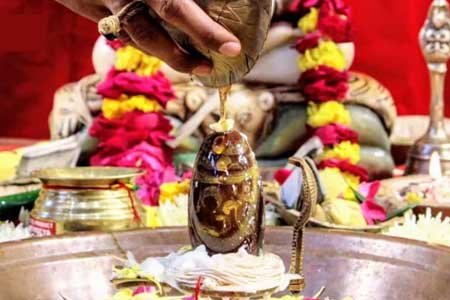 1. Mahamrityunjaya Jaap in Varanasi (Kashi) is performed for those suffering from chronic diseases, before and after surgery for faster recovery, for protection, and for overall well-being. It is a time-tested remedy whose importance has been passed down through generations, making it the most sought-after Pooja in Varanasi. As the abode of Shiva, Varanasi is the most favourable and beneficial place for this Pooja.